
From Injustice to Action: David McNair on Shaping Global Policy and Climate Solutions
Anaaya PATIL
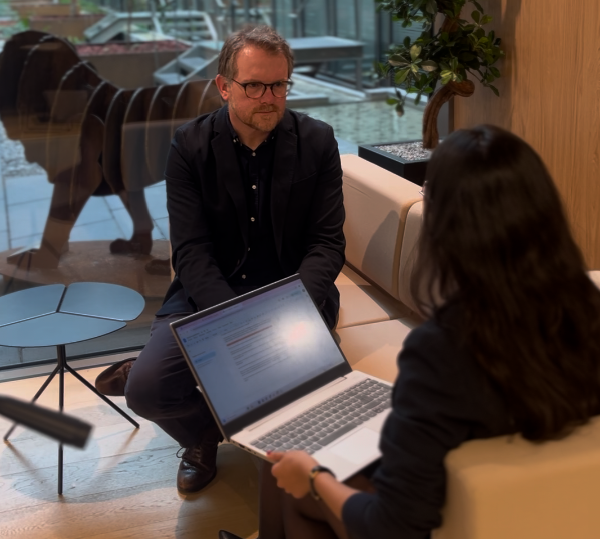
“I always wanted to tackle causes” stated Mr David McNair, executive director at the ONE campaign, in conversation with Anaaya Patil, a member of our press team.
Mr McNair, nonresident Scholar at the Carnegie Endowment for International Peace, working in the Global Order and Institutions program, a council member at the European Council on Foreign Relations, and a Board member of the Africa Europe Foundation, spoke with us about international development, climate policy, and the role of the youth in shaping global solutions.
Q1: What first motivated you to pursue a career in international development and global policy?
David McNair
I think it was the idea of injustice. I grew up in Northern Ireland during the 1980s, during the conflict there, which was in many respects quite an insular context. And when I had a chance to travel and saw the inequalities around the world, it had quite a profound effect on me. At that moment I said, I want to understand why these inequalities exist and do something about the underlying causes. I always wanted to tackle the causes. So that meant I got involved in a number of different campaigns on international debt cancellation, on the role of tax havens in facilitating money flowing out of poor countries into rich countries and since then I've done a lot of work on the international stage with the World Bank with the IMF with G20 governments to try and put in place policies that are more fair and channel more resources to countries that need them most.
Q2: As you said, you've worked with governments, NGOs and international institutions. How do these sectors differ when it comes to solving global challenges? On what level are they impactful?
David McNair
It really depends on the specific challenge. A lot of governments will interact through processes at the UN, at the World Bank, at the IMF, at the OECD, and they will present their country's position and then try to come to a consensus. But often those processes are quite process heavy and very slow moving. So non-profit organisations, civil society organisations often try to come and bring new ideas, inject energy, and bring domestic political capital through mobilising people to push governments to go further in these international processes. So they all interact in different ways and they all have different roles. But it's really important that you have these different players that are trying to grease the wheels of the system.
Q3: How can institutions like the United Nations ensure that global resources are protected when, especially in rich and developed countries, national interests come first?
David McNair
I think it's a really difficult moment because in a sense the UN was created out of the ashes of World War II and the idea was it's better to talk than to fight and sadly the way our governments are going now at the moment, they seem to favor fighting over talking. And the UN is losing a lot of influence. So I think the key thing is that the UN needs to kind of come back to those core principles of humanity and the UN Charter. But I think the UN Charter also needs to be updated for today, because if you think about it, the UN Charter was written in the era before the internet before nuclear weapons were ever used before artificial intelligence and the world has changed a lot and we need a kind of new system to be able to manage that.
Q4: What are the biggest obstacles preventing countries from effectively sharing responsibility in contributing to global warming and burning fossil fuels?
David McNair
I think it's about misaligned incentives. Governments, particularly democratic governments, operate on short cycles. The primary driver of them being elected is the economic situation in their country. You've got the demand for short-term economic wins and the climate catastrophe is about a long-term need to sustain our planet. And those incentives don't always align. In fact, most of the time they don't align. And we need to find ways of building domestic political constituencies so that even within those political electoral cycles, politicians feel that these issues are something that they're going to be held to account for.
Q5: You spoke about China and other countries as an emerging economic superpower. Is that why some global and environmental needs get put on the back seat? Because of economic priorities?
David McNair
Yeah, I think that's partly true. Although if you look at the innovations around renewable energy, China is way out in front in terms of reducing the cost of solar energy, expansion of renewables both within China and globally. And part of that is that China isn't a democracy, so it can think more long term. And that's something that is not a luxury that's afforded to a lot of other countries.
Q6: How can wealthier nations support them effectively without not considering themselves a priority?
David McNair
And I think it's about having leaders that are farsighted and recognize that they need to not just consider the next political cycle but they need to consider the next generation and I think it's also about citizens, particularly young people saying this stuff matters and if you want our vote you need to prioritize it. I think without that kind of pressure then all of these international processes and systems don't really work because it's all about the incentives of the individual leader to prioritize these issues.
Q7: How much more crucial is public finance compared to private investment in addressing climate change?
David McNair
I think what you need to do is identify what's the right type of finance for the right type of project and the right type of country. So for low-income countries, they often don't have access to international markets and therefore they really need public finance. They need climate finance aid, the kind of money that will support basic public services and resilience to climate change. But there are middle-income countries where they have growing businesses that can attract private investment. And therefore, that scarce resource of public finance needs to be channeled where it's needed most. And often it isn't because it pursues the political priorities of the donor rather than where the needs actually are.
Q8: Do you believe the current global financial system adequately supports climate mitigation and adaptation?
David McNair
Well, I think there are a few different elements to that question. The first is the scale. So the scale of the needs are much, much greater than the financing available. Then there's a regulatory question about what will make international capital flow, and there are trillions in pension funds, in private banks, but often they go to what are considered safe investments in rich countries, when actually it would be much more productive for them to be investing in green energy projects in emerging economies. So we need to tweak the regulation and make the political case that public finance needs to be much larger.
Q9: If you could implement one global policy to better manage global public goods, what would it be and why?
David McNair
I think there's one element of public policy, but there's another element of politics. And I think policy is always downstream from politics. Politics is always downstream from culture. And I think we need to be working much more upstream at saying we need cultural leaders to be saying that these issues are important. And then we need political mobilizers that are kind of organizing networks that will go and meet with their elected representatives and say that these issues matter. From that political pressure will emerge public policy solutions and there are lots of you know there are thousands of great ideas that never get implemented because there's no political space to implement them. So I would go upstream and say we need movements of young people to create the space for the technical ideas to be implemented.
Q10: How can youth voices be better included in international climate negotiations?
David McNair
Well, there are lots of mechanisms for young people to attend climate conferences and so on. I think those are kind of quite tokenistic and don't really have much impact. Because what's really happening is that government negotiators are representing the interests of their country and therefore, I think the real action needs to happen ahead of elections, in local constituency offices when people go and meet with politicians to say we want you to prioritise climate action in the government. That then becomes part of the programme for the government who negotiates in those international settings.
Q11: In your experience, what skills are most important for young diplomats or policymakers trying to solve global issues?
David McNair
I think you need to be able to communicate. A lot of these issues are highly technical and unless you can relate these issues to what matters in people's everyday lives and build trust and networks among people who are pushing in the same direction, then it's hard to get anything done. And what I've found in my work is that there are people that I've met over 20 years that might be doing something one year and then five years later they're in a really influential position. If you can build that relationship, then when they are in that influential position, you've got influence over them when they have influence over international issues.
Q12: Have you met more and more youth that are interested in the subject?
David McNair
Yes, and the organisation that I work for, The One Campaign, has a big youth mobilisation element. We have a programme called Youth Ambassadors across Europe. They will apply, become part of a programme where they'll learn about the issues, they'll learn how to speak to politicians, and then they'll regularly go to the European Parliament, for example, to meet with the relevant committees. That has a real impact because politicians care about their domestic constituents and they love meeting young people.
Q13: Looking back at your career, what experiences have shaped your perspective the most on global cooperation?
David McNair
I think it's a combination of understanding why these issues matter, so meeting people who are really affected by the issues. And 20 years ago, I would have said people living in rural Kenya when I go on a trip with them, but increasingly it's actually people who are affected by heat waves in Europe, it's people whose homes are flooded, and it's no longer a kind of rich per country issue, it's affecting everyone. So the first point is the need, but then the second point is meeting people who are pragmatic and are prepared to get to know people, understand the technical details, do the hard work, but also make compromises to get stuff done.