
From Partnerships to Global Health: A Discussion with Babatope Akinwande
Kira BLAMPOIX
“If you are healthy, you can think and you can dream.”
This interview features Babatope Akinwande. Currently, he works for the WHO Academy in Lyon as the team leader for partnerships and resources mobilization, meaning his goal is to create partnerships and mobilize both financial and non-financial esources for the WHO Academy to carry out its mission and objectives. In a nutshell, he has been an international civil servant for the majority of his life. His past experience includes working with the UN, UNICEF in New York and in Senegal, the International Atomic Energy Agency in Vienna and UNAIDS in Geneva and Senegal.
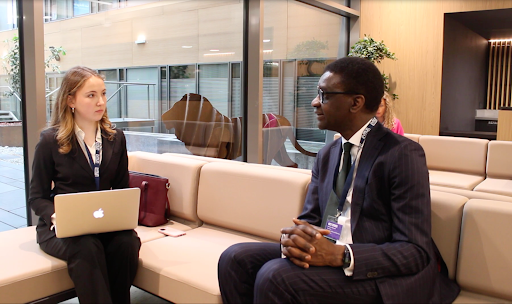
Seeing that you are specialized in resources and partnerships mobilization, how do you convince and encourage organizations to help in your cause?
We have to show them the results. We have to show them what we have achieved and, especially at this very difficult time in the private sector, we have to show them a return on investment. We see funding from donors as an investment and not just money given to us to do what we like, but instead to invest. Anybody would like to see a return on investment and that's exactly what we do and it's been successful.
In your opinion, what are the main obstacles and structural barriers that are preventing society from having accessible healthcare?
I think there are numerous obstacles and one of them is the huge poverty in some different parts of the world. When you don't have enough financial wherewithal, there's no way you'll be able to provide health for everybody. It's also very important that you have very good, solid health structures. Additionally, where there's limited education, people don't think about those types of things. When people are not well educated, they do not understand what their rights are in terms of health. So I would look at education, poverty and lack of health infrastructure as a key issue that prevents people from getting the right health.
Since poverty is such a main issue, to what extent do you think wealthier countries should be helping lower income countries?
I believe very strongly in solidarity and in wealthier countries sharing whatever they have with poor countries. But I also believe that what I would call the so-called poor countries should also see health as human rights. If you look at the map of the world, each country has something that could make them wealthier. There is no country you'd look at on the surface of the earth that does not have something that, if well managed, would not improve the lives of their citizens. So, while I agree that richer countries should help the so-called poorer, the latter should also ascribe to being able to take care of their citizens. I believe that things must be well managed, thought through and forged through global solidarity. However, there's also the responsibility of each country to think of taking care of their citizens.
How can we teach countries to sustain their improved healthcare?
That's one of the reasons why the WHO Academy came to exist. The main thing is to help health workers in lower/middle income countries to have the basic knowledge to be able to take care of their citizens. In some countries, you can find a nurse who has graduated 10-15 years ago but has never had a refresher course. Knowledge must be kept up to date. The Academy seeks to help lower and middle income countries to continue on a lifelong learning path.
Are there any new technologies or innovations on the horizon that could seriously help this issue?
In the academy where I work, we have seen it through our vast online learning. Obviously, we are all aware of AI. For example, we are developing some courses that would have taken us six months. And with the right use of AI, these courses could be developed in a week. So it's something we all have to watch out for and we are taking it very seriously at the WHO.
How realistic is it that these innovations could be applied in countries with limited infrastructure?
You would be surprised. I think when the internet and the mobile phone came, we had the same debate. I totally agree that there is still a problem of infrastructure and inconstant electricity, but what matters is the will of the people wanting to better the lives of young people. We have a lot of health workers living in Africa and Asia coming online for our courses. The pace might be slow, the internet might not be as strong as in a place like Lyon, but we still see people coming online and being able to take the course. This is where we can also support the government with this technology or give them the means to access this technology.
How can international organizations help support these countries?
Through technology and knowledge transfer and financial support. For example,for seven years I was working at the International Atomic Energy Agency at the Program of Action for Cancer Therapy. I was working on a project on peaceful use of nuclear technology. And the UN was the only agency which had the mandate to use the nuclear technology for what we call peaceful use. You've heard people having radiotherapy, somebody having cancer and getting treated easily. But that's not the case in many countries because they don't even have radiotherapy facilities. So the International Atomic Energy Agency helped most of those countries to develop the use of radioactive nuclear technology to be able to treat their patients. My role was to help them to find cancer centers where oncologists could be trained. I worked with cancer centers in France, the US, the UK and what we call the South to South cooperation in Morocco to train some cancer specialists in certain francophone countries.
What have been some major setbacks?
Conflict. I've worked in conflict-infested areas and I've had promising projects interrupted or stopped. I've been in countries where there have been wars making me have to leave overnight, leaving all the projects behind. Conflicts and geopolitical crises are the biggest problem. And right now, what we are going through is the global financial crisis, which is affecting all the organizations, including the WHO.
How can we help countries in conflict despite difficult access and unstable governments?
Interestingly, some years back I was involved in conflict resolution in Liberia. I was working mainly with the media before the elections in terms of the messages published in the media, training media specialists. I worked as a journalist for the BBC around 20 years ago. I remember organizing a training for journalists on election reporting. There's a lot of fake news. So we targeted journalists and told them about responsible reporting. We can find ways to work even when the countries are in conflict. I also worked with the Red Cross. You can do a lot of training and advocacy. Another project that I worked on was encouraging young people to be responsible, to see themselves as leaders of tomorrow. That's very important for us. For example, when I was at UNICEF, we had a Young Leaders of Tomorrow program. It aimed to help students to start thinking of themselves as leaders and participants in global relations. We try to give people a sense of responsibility from a very young age.
What has motivated you to work on this issue?
I think health is wealth. My father wanted me to be a medical doctor so I became quite interested in health from my early childhood. But as I grew older, I realized that one of the greatest things was good health. If people have access to good health, you will see the number of educated people rise. When you are healthy, you can think and you can dream. Health is at the basis of everything. I didn't come to this realization that I'm sharing with you overnight. I've traveled around to many countries, both very rich and very poor. In France, your priority is not to think about where to go. It's more, “do I want to go?” or “do i like this doctor?”. But if you go into some other countries, they don't even have basic health facilities. Even in rich countries there's a huge gap. Widespread health is what a country needs for a good quality of life.
How do you overcome obstacles?
Don't take no for an answer. Keep asking. Do some internal reflection and maybe change your approach. They say that if you cannot climb a mountain, find a way around it. That's my personal belief and I think we should make it collective. The fact that you say no is not the end of the world. I'll go back and reassess my strategy and come back to you. When we get up to a point where we cannot do something, we can go out and seek help. Every country, every human being, has resources in them. Nobody is useless. Everybody has value. I always tell young people, such as my children: nobody is stupid. Everybody is smart. Everybody's talented. So what do we have to give? Because we should also look at international development as a situation of give and take. If we don't get something from a country, we go to another or we ask ourselves, what can we do ourselves?
What message would you like to share with students participating in a conference like this one and seeking to help?
Be curious. You may ask what curiosity has to do with health. If you are curious, you will be worried, you will ask yourself questions about your environment. You will wonder why other people your age don't go to school, don't have good health, get married as pre-teens … Curiosity will push you to find solutions. If you are curious, you will find challenges, and then behind challenges, you will need to find solutions. So I believe in trying to understand your environment and its surroundings.