
Interview with Valdecy Urquiza, Secretary General of INTERPOL and Keynote Speaker, ILYMUN 2026
Awujoola Akinwande and Hannah Herd
Valdecy Urquiza, the Secretary-General of the International Criminal Police Organisation (INTERPOL) since November 2024, spoke as the keynote speaker at ILYMUN 2026. Urquiza, who previously served as a Vice President of the Americas on INTERPOL’s Executive Committee between 2021-2024 and as the Director of International Cooperation for the Brazilian Federal Police, gave a pertinent speech on the role his organisation plays in delivering justice and maintaining the rule of law globally, in addition to answering the ILYMUN Press’ questions on how his organisation’s work and his career link to this year’s conference’s theme of : Justice in Motion: Building Trust, Protecting Rights.
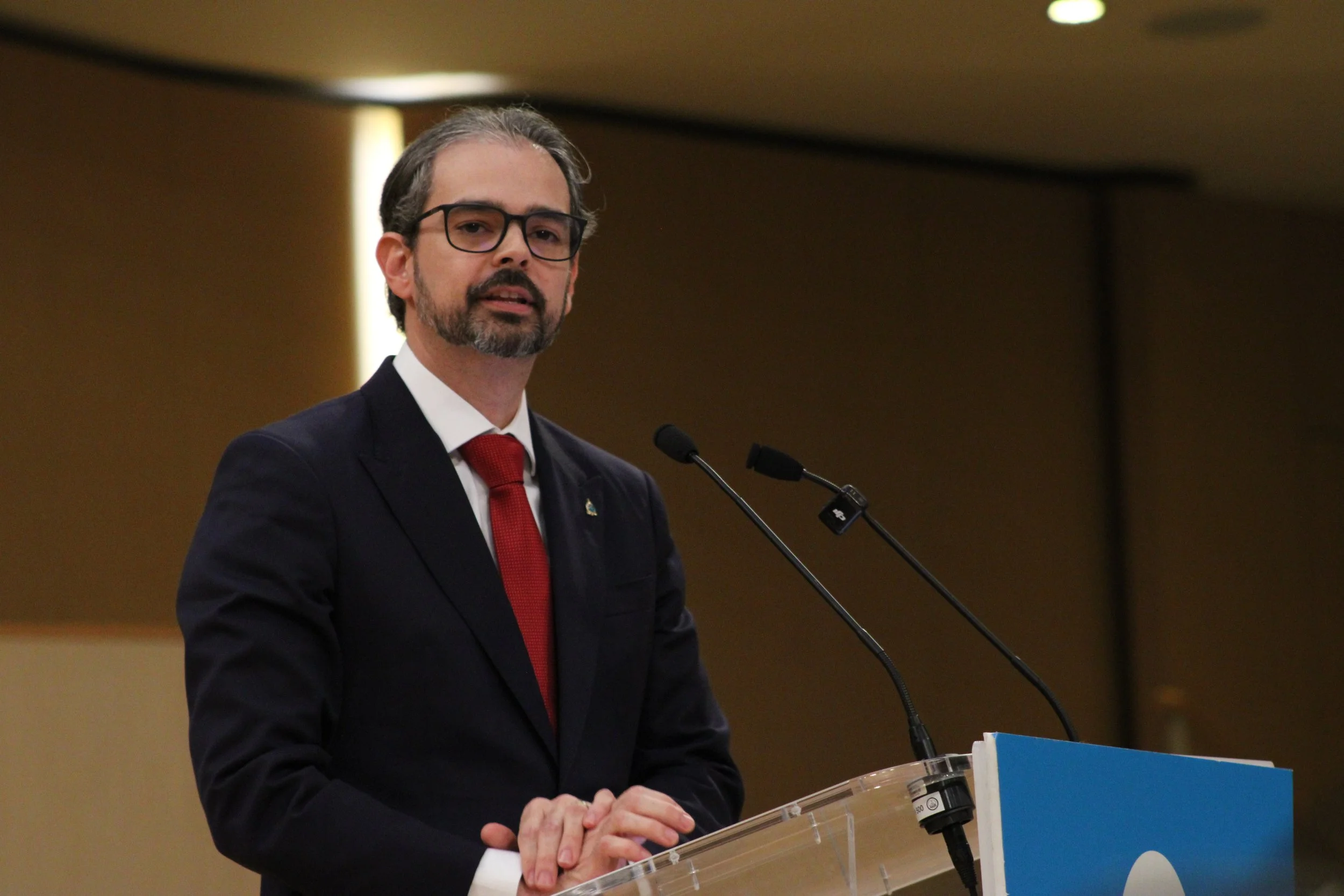
Mr Urquiza speaking as the keynote speaker at ILYMUN 2026.
(Credits: ILYMUN Press)
What inspired you to pursue a career in law enforcement?
Like many people in law enforcement, my motivation began with a simple idea: to contribute to the development of my country, serve my community and support the justice system.
But over time, through my work in policing at both the national and international levels, that motivation evolved into something broader. I came to understand that crime today does not respect borders, and that protecting communities requires strong cooperation between countries, institutions, and people.
What drives me is the opportunity to make a meaningful impact - whether by strengthening international police collaboration, protecting vulnerable communities, or helping law enforcement agencies around the world work together more effectively to combat transnational crime.
Ultimately, the goal is the same: to help create safer societies and ensure that justice and security reach people everywhere.
As the first non-European/American Secretary General of INTERPOL, what unique perspectives do you bring to global policing?
Leading an international organization from a Global South background brings a perspective that is shaped by diversity, adaptability as well as an understanding of the realities many countries face.
In many of our member countries police officers work in environments where resources are more limited, where institutions must innovate to deliver results, and where international cooperation is not an abstract concept but a daily necessity.
As Secretary General, no matter the nationality, it’s important to listen carefully to ensure that global solutions are truly inclusive and practical for all member countries - the role is about serving the entire international community.
Ultimately, what matters most is not where a leader comes from, but the ability to build consensus, understand different realities, and bring countries together around shared goals.
In today’s interconnected world, that diversity of experience is a strength for international cooperation.
How does INTERPOL enable effective international cooperation among its 196 member countries with differing legal systems and resources to combat complex transnational threats like cybercrime, human trafficking, and organized crime, while building trust and upholding human rights?
INTERPOL’s ability to enable effective international cooperation among 196 member countries is rooted in a simple but powerful foundation: neutrality, shared rules and more than a century of experience in police cooperation.
For over 100 years, INTERPOL has served as a neutral platform that allows law enforcement agencies from very different legal systems, political contexts and resource levels to work together even - and especially – where no diplomatic relations exist.
What makes this possible is the clear framework set out in INTERPOL’s Constitution.
Article 2 defines our core mission: to ensure and promote the widest possible mutual assistance between criminal police authorities, within the limits of national laws and in the spirit of the Universal Declaration of Human Rights. This principle ensures that cooperation is both effective and respectful of fundamental rights.
At the same time, Article 3 safeguards the organization’s neutrality by strictly prohibiting INTERPOL from undertaking any intervention or activities of a political, military, religious or racial character. This neutrality is essential to building trust among our 196 member countries and ensuring that INTERPOL’s channels are used solely for legitimate law enforcement purposes.
In practice, INTERPOL provides a secure network that makes cooperation possible. Our private secure police communications system allows officers in different parts of the world to exchange information instantly. Our 19 global databases from wanted persons and stolen works of art to DNA and travel documents help countries connect the dots across borders.
Equally important is our work to strengthen capabilities. Not all countries have the same resources or technological capacities, so INTERPOL supports training, operational support and access to tools that help level the playing field.
By strengthening the ability of all member countries to participate effectively, we strengthen global security as a whole.
Ultimately, INTERPOL’s role is to act as a trusted bridge, enabling cooperation across borders while respecting national sovereignty, human rights and the rule of law.
In a world where criminals operate internationally, that trusted framework is more important than ever.
Our MUN theme focuses on building trust and protecting rights. How do you see the role of international policing in promoting justice, particularly for vulnerable populations?
International law enforcement cooperation plays an important role in promoting justice because many of the crimes that most affect vulnerable populations, such as human trafficking and child exploitation, are now transnational.
No country can address these threats alone.
INTERPOL helps bridge gaps by enabling police around the world to share information quickly, coordinate investigations and identify victims who might otherwise remain unknown.
At the same time, this cooperation helps ensure that fugitives cannot evade justice simply by moving across borders.
Ultimately, effective international policing is not only about catching criminals. It is also about protecting people, especially those who are most vulnerable, and ensuring that justice can reach them wherever they are.
How do you envision the role of INTERPOL in a future where crime increasingly crosses borders and becomes more technologically sophisticated?
I see INTERPOL moving forward in three key ways: supporting greater international cooperation, developing stronger technological capabilities and forging deeper partnerships.
First, no country can tackle transnational organized crime alone. Criminals move money, data and people across borders almost instantly. This means law enforcement must be just as connected, sharing information quickly and working through global platforms that allow officers to collaborate in real time, no matter where they are.
Second, police services will need to continue strengthening their technological capabilities. Criminals are already exploiting digital platforms and emerging technologies to scale their activities. Law enforcement must invest in digital expertise, data analysis and innovation to anticipate and disrupt these threats.
Finally, the future of policing will depend on stronger partnerships — not only between countries, but also with the private sector, academia and civil society. Many of the systems criminals exploit, particularly online, are owned or operated by private companies, so cooperation across sectors will be essential.
Ultimately, the mission of law enforcement will remain the same: protecting communities and upholding the rule of law. But achieving that mission in the future will require a more connected, more agile and more collaborative global approach.
In a polarized world with declining trust in institutions, what role can youth and civil society play in supporting justice and accountability globally, and what advice would you give to young leaders interested in careers in law enforcement, international relations, or human rights advocacy?
Today the role of youth and civil society is more important than ever.
Young people can play an important role in keeping institutions accountable, as well as bringing new perspectives to complex challenges.
Civil society organizations often work closest to communities, particularly those who are most vulnerable.
They can highlight emerging issues, support victims and ensure that discussions about justice and security remain grounded in human rights and the rule of law.
For young leaders interested in careers in law enforcement, international relations or human rights advocacy, my advice is first to stay curious and open to different perspectives.
The challenges we face today, from transnational crime to digital threats such as deepfakes, are complex and interconnected.
Understanding different cultures, legal systems and viewpoints is a major strength.
Second, remain guided by values. Integrity, respect for human rights, and a commitment to public service are the foundations of any career dedicated to justice.
And finally, be patient but persistent. Meaningful change rarely happens overnight, especially within large institutions.
But with dedication, professionalism and a willingness to collaborate across borders and sectors, the next generation of leaders can help build stronger, more trusted institutions that are better equipped to deliver justice and accountability globally.
Looking back on your career, what advice would you give your younger self starting out in law enforcement and international cooperation?
I would say never forget why you became a police officer. You did it to serve. To protect. To contribute.
