
Entrepreneurship and Geopolitics: Navigating the World of Business in Uncertain Times - Interview with Franck Glaizal
Theadora Beavan
"Geopolitics is everywhere", explains Franck Glaizal, a private equity investor and geopolitics speaker from the Lyon International Club. At ILYMUN 2026, I had the chance to speak with Mr. Glaizal, who draws upon his years of experience across various industries and markets to share his unique insights. In a world where the markets are increasingly impacted by global events, his advice highlights the relevance of understanding geopolitics when navigating modern business.
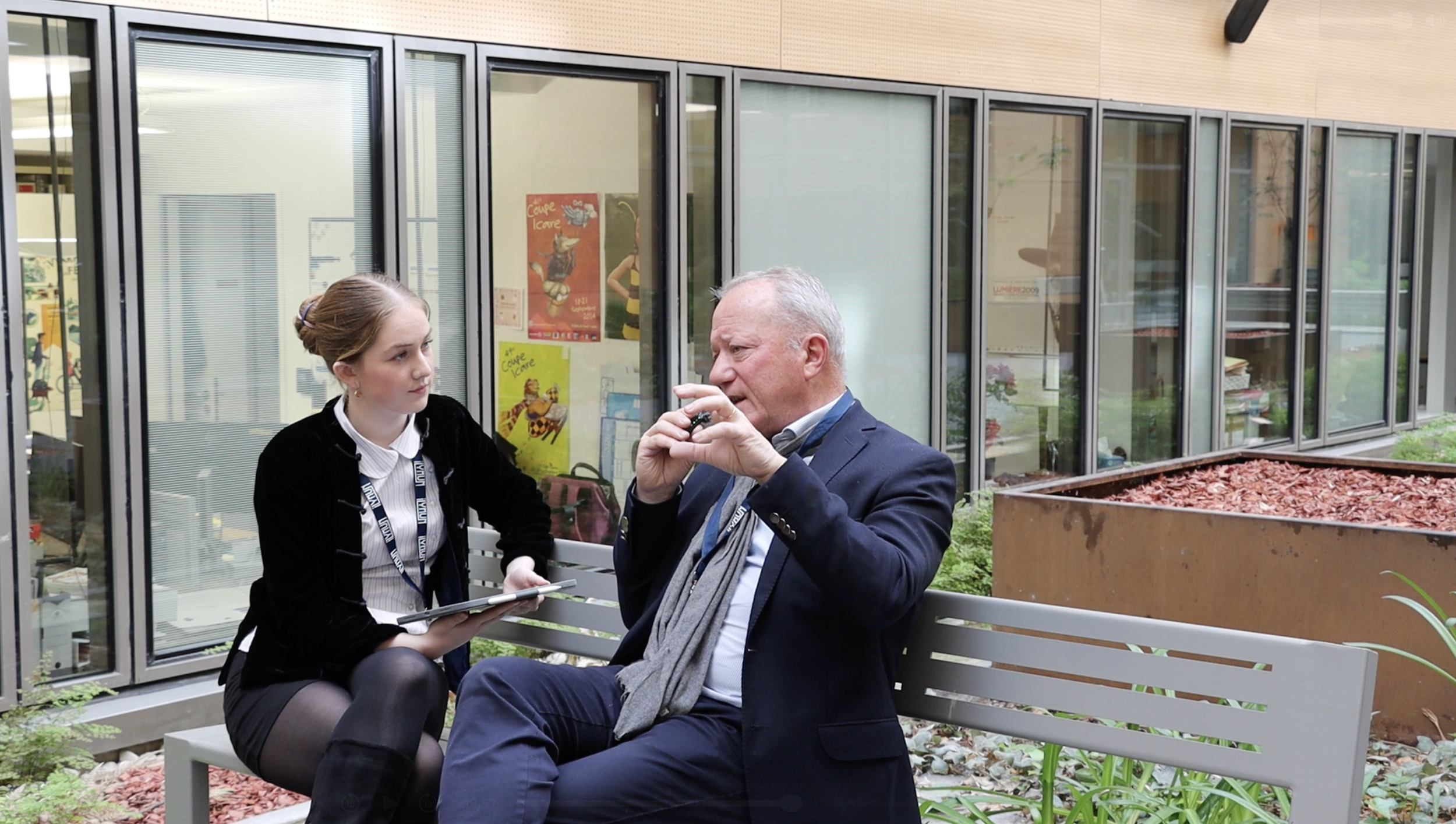
FRANCK GLAIZAL: My name is Franck Glaizal. I am 68. I used to be a businessman. I had my own company in Italy and in New York. I currently run my own private equity fund, investing in small companies active in the organic cosmetics sector. I am also Vice President of Links, the International Club. I am very active in the Cercle de Geopolitique de Lyon, and I give many conferences on geopolitics.
INTERVIEWER: You have shown a strong interest in geopolitics. What is the best and most efficient way for business leaders to integrate geopolitical thinking into their corporate strategy?
FRANCK GLAIZAL: First of all, it is extremely important to integrate geopolitical knowledge into business, into companies, and into your own way of thinking, because the world is currently living through incredible revolutions. Energy, the environment, oil, electricity, the return of empires, big tech giants, the power of social networks, and the power of artificial intelligence.
It is difficult to understand everything that is happening today. So you have to dedicate time to reading. Moreover, you should try to get informed outside of the usual mass media, especially French mass media, which often repeat the same narratives without deep analysis.
Being able to speak foreign languages, such as English or Italian, allows access to different sources of information that provide new perspectives on reality.
For example, today, if you do not understand the geopolitics of oil, gas, and energy, it is very difficult to be a good investor. Geopolitics is now everywhere. If you do not understand new forms of hybrid warfare, including online propaganda and information manipulation, it becomes difficult to understand how public opinion and elections can be influenced.
So geopolitics is everywhere. When you manage a company, an organization, or a team, you must stay informed and understand what is happening behind the scenes.
INTERVIEWER: In your opinion, what are the biggest geopolitical threats to Europe right now?
FRANCK GLAIZAL: Europe is currently facing many serious threats. If you want to understand the threats to our sovereignty, which ultimately affect our way of life and purchasing power, you should read the Draghi Report.
Mario Draghi, the former President of the European Central Bank and former Prime Minister of Italy, produced this report. He is one of the most respected European leaders today.
The report explains clearly what Europe must do to regain strategic independence. European leaders such as Friedrich Merz, Emmanuel Macron, and others must apply the recommendations of the Draghi Report if Europe wants to escape its current situation of dependence.
Europe must regain strategic autonomy, and applying the recommendations of the Draghi Report is one way to achieve this.
INTERVIEWER: What do you think the influence of social networks is on geopolitics today?
FRANCK GLAIZAL: The influence is huge. It was actually the main message of my speech this morning.
The combination of artificial intelligence and social networks managed by powerful technology leaders such as Sam Altman, Sundar Pichai, Elon Musk, and influential political figures like Steve Bannon, JD Vance, and Donald Trump creates an extremely powerful communication ecosystem.
Take the example of TikTok. It has billions of users, many of whom spend two or three hours a day on the platform. If fake news is constantly repeated and amplified through such networks, it can influence the thinking of billions of people.
This is very dangerous. International organizations such as the United Nations should consider establishing regulatory frameworks for social networks. For example, in France, newspapers must respect press laws and regulations. Something similar may eventually be necessary for social networks in order to define clear rules for how these platforms operate.
INTERVIEWER: Do you think geopolitical instability has changed how companies make decisions today?
FRANCK GLAIZAL: It represents a huge transformation for companies.
For example, how can you build a long-term strategy to expand your company and export to the United States when you face unpredictable policies, such as sudden tariffs announced through social media posts?
This type of unpredictability creates uncertainty for businesses.
The world is changing significantly, and recent political decisions have had major consequences for global companies. As a result, some countries are now trying to strengthen trade relationships without relying as heavily on the United States.
For example, the European Union and India are developing stronger trade relations. Similar discussions are taking place with countries in the Pacific region, including Canada, Australia, New Zealand, Chile, Mexico, and Singapore. These agreements aim to create large free trade zones that allow countries to diversify their economic partnerships.
When you manage a company today, you must be very careful when operating internationally. But even domestic companies are affected by geopolitics.
For manufacturing companies, the price of energy is a critical factor in competitiveness and efficiency. Being able to anticipate energy prices is therefore extremely important. In this way, geopolitics is now at the center of corporate decision making.
INTERVIEWER: A lot of advice is given to young entrepreneurs, but the reality is that many startups fail. What uncomfortable truth about entrepreneurship do you think people do not talk about enough?
FRANCK GLAIZAL: Many startups fail, but that is normal.
If you look at the statistics, out of five startups, three fail, one survives with moderate success, and one becomes a major success. That is simply the reality of entrepreneurship.
Building a successful startup is a real challenge. It is like being admitted to Harvard Business School or Stanford. It is not for everyone. It requires specific skills and the right partners.
You need two kinds of partners: financial partners and experienced partners who can help you manage and anticipate the development of your business.
If you have the right team and the right support, you have a better chance of success. But nobody is guaranteed success. That is simply part of the entrepreneurial journey.
INTERVIEWER: After years of working in global corporations and consulting, have any of your beliefs about leadership or strategy changed?
FRANCK GLAIZAL: I do not think the fundamental qualities of leadership have changed very much. A leader still needs vision, strategy, and the ability to guide a team.
However, young people today have far more opportunities to create businesses than we had forty years ago. Technology creates new opportunities every decade.
When I was young, the economy was more traditional and innovation cycles were slower. Today, technological innovation in digital technology, environmental science, artificial intelligence, and social organization creates many new opportunities.
There are also more investors and mentors available to support startups, creating a much more dynamic environment for entrepreneurship.
But a leader must still possess one essential quality. Winston Churchill said that success is never permanent and failure is never final. What truly matters is the courage to continue.
You must keep fighting, keep working hard, and keep building strong teams. If you do that, you give yourself a much greater chance of success.
INTERVIEWER: What do you think are the biggest challenges and most common mistakes made by European companies competing globally today?
FRANCK GLAIZAL: European companies actually operate in a more complex and difficult environment than many American companies for structural reasons.
Europe has many strengths. We have strong companies, a powerful economy, the largest single market in the world, and excellent universities.
One of the main challenges is that our capital markets are still not fully unified. The biggest difference between Europe and the United States is cultural.
In the United States, entrepreneurship is deeply embedded in the culture. Many people aspire to build their own businesses and create wealth.
In Europe, cultural and political barriers sometimes discourage entrepreneurial ambition.
What Europe needs most is more entrepreneurs.
European companies are highly competitive globally despite operating in a difficult regulatory environment. What we need now is a new generation of entrepreneurs who will help strengthen Europe's economic future.
INTERVIEWER: Thank you very much.
FRANCK GLAIZAL: Thank you.