
ILYMUN Represents Hope - An Interview with Robert Miller
Eva Sussman
Robert Miller, former Head of the CSI Anglophone Section, was a guest speaker for the Historical Security Council. It was a special opportunity to hear about the challenges faced during the 1958 Algerian War. Mr. Miller was also one of the founding members of the ILYMUN conference and helped it to grow to the success that we know today.
Over the years, ILYMUN has become an important event that brings students together to debate global issues, develop leadership skills, and better understand how international cooperation works.
I had the opportunity to sit down with Mr. Miller and discuss some of the past and present experiences of the ILYMUN Conference.
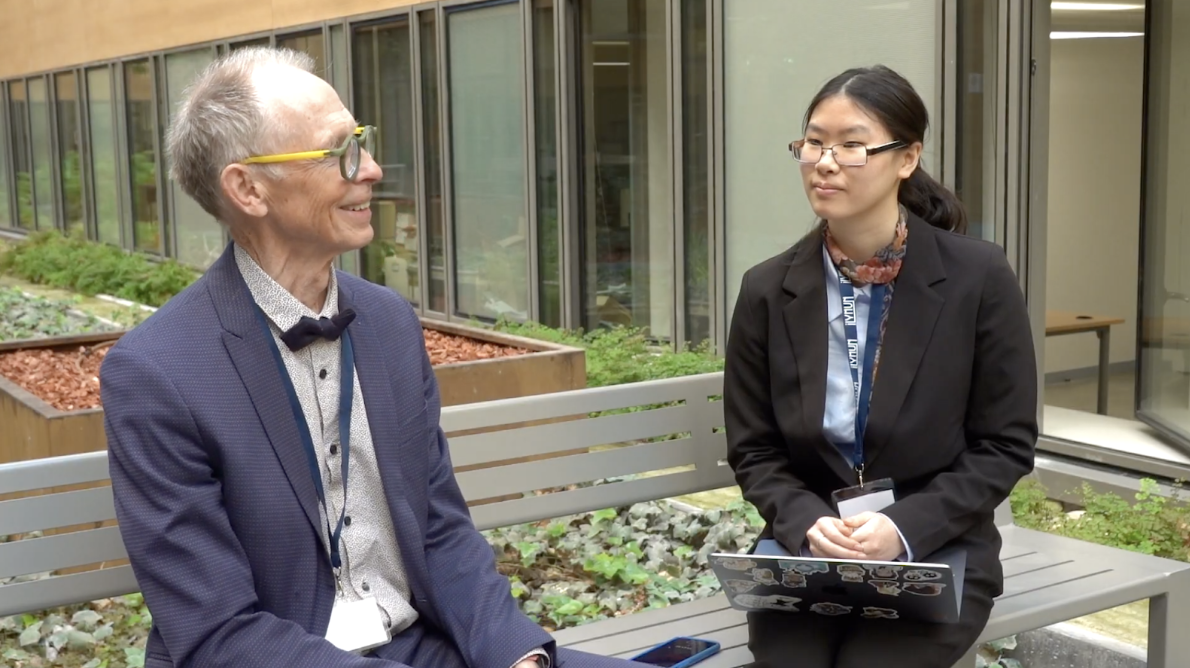
Eva: Mr. Miller, I have been reading about how ILYMUN all started. Can you tell me more about what it was like at the first ILYMUN conference?
Robert Miller: It was very chaotic. I had the experience of arranging a couple of conferences before, but not of this scale. It was to do a joint venture with the ISL. That partnership was created and we put a group of students together, we brainstormed everything and we were kind of working at it all the time cause we didn’t have the experience, the logistical experience, the kind of experience that comes with time. So, the first conference was very raw, it was very exciting and very fulfilling and we created a model where that still exists today so it was a very worthwhile experience.
Eva: How do you feel things have changed at ILYMUN over the years and do you feel that there are any notable differences now?
Robert Miller: Well definitely in the smoothness and professionalism of the organisation, that's developed with time. Mr. Badou's presence is very very beneficial for the smooth running of this conference. It's all the preparation that he and Mrs. Trout do.
As for differences, I think on the whole, when you look at it, the success of this conference depends upon the individuals involved. So, looking at differences and developments is the same, it's the level of professionalism and seriousness which we find in the organisations. We also find it in the quality of the debates which is also thanks to the teachers involved in the organization outside Lyon.
Eva: Since you mentioned education being a really big part of it, when you first started this, what kind of education were you hoping students would get from this?
Robert Miller: Well, it's a little bit twofold but the general understanding of how the United Nations works, the importance of global institutions, and the role that they should play in the world. It’s learning the kind of process that can be found through working collaboratively and how beneficial it is to work as a group to find solutions. The other part is all of the communication skills that are involved. Taking the floor, taking on the role, understanding how other people think, and all those sort of aspects of it. So there’s multiple experiences that you have if you are involved in ILYMUN, even if you are in the school that is coming to ILYMUN, it's that process that you’re going through.
Eva: Ok, then can you explain a little bit more on how ILYMUN can help students to learn about real world issues?
Robert Miller: I would say that there aren't many students who think about the role of justice in the world and what are the responsibilities. So, it's getting [students] to think in those kinds of lines. It's also for them to be able to appreciate where different arguments come from and the point of view of a country. Questions like, why is it different from mine, and then how can we work on the differences. There’s a learning process to understanding what is not ok, what is fact, what is the origin of that fact, and how that fact can be used potentially for a solution to a problem. This kind of learning, how to work together, and working through these problems, is the real way in which we should be moving and getting more people to understand.
Eva: This year’s topic is about justice in motion, building trust and protecting rights. Do you feel this topic plays an extra significant role in students’ lives today?
Robert Miller: I feel that it should play a greater role. My argument is always that we should have national and international institutions whose basic aim is justice. And, for justice, you need to recognise human rights. Rights of all entities on this planet so it's showing respect for them. So when you look at justice, it's not just the face of it (I do this act and I'm punished for doing something which is wrong), it's making sure that there is justice in the equitable division of resources as well. The equitable division of resources respects the environment at the same time. So it's got to be justice on all different levels. There's justice for the individual, justice for society, but justice for the planet at the same time. And in order to achieve that, you need the institutions and power in those institutions. We have institutions, we have the United Nations, but what is happening at the moment? The United States is not paying to support the United Nations. Trump is trying to set up an equivalent of a new form of the United Nations, to serve what? It doesn't serve the basis of the planet at all. How it's achieved, I don't know, but going back to the role for the students coming to this conference, I hope they become aware and re-evaluate the role of these global institutions in creating justice for the planet.
Eva: You have spoken in the past about how more power should be given to the United Nations. What's your opinion today and do you feel the same way?
Robert Miller: Yes, I feel even stronger about it. I remember going to the conference in 2023, talking about the role of the United Nations. The conference was based on the states and the power between the states. My argument then was we need to have a strong central organization in order to counter the rogue elements that we find on the planet. You know, how can we counter somebody like Trump in the United States who ignores the very threats that we have to the planet? How can we ensure that people [like him] don't dominate global politics such that these threats are not addressed? Without more power, how can we possibly focus on development if there is no recognition of the threat of climate change and our role in creating these conditions? I find it incredible that we just don't think about future generations.
Eva: Do you feel that the ILYMUN experience can help students to build trust in the UN?
Robert Miller: Well, to build trust in anything, it's got to be seen as an honest institution, which I think most of us think it is. But it's got to have some form of power. And when you look at all of the countless resolutions which have been drawn up that would really benefit the planet and individuals. But not much has come out of those resolutions. The palestinian crisis whose resolutions date over more than 50 years. It is the power of an individual state that overrides these resolutions. The United Nations has a sense of authority which should ensure that the globally agreed upon resolutions can actually be put into place. It shouldn't be just a place where things are discussed and good views are expressed and plans are made. Those plans have to actually be achieved.
Eva: If you were to list the three most important lessons or takeaways from the ILYMUN experience, for you and the students, what would they be?
Robert Miller: As an educator, I think it's key the way in which you learn by doing. That's the key thing. I think what I love to see is the energy and the wish to develop. The idealism I find in youth, I think that's extremely important. When we retire, that's something we miss. We miss talking to young people and seeing how they react and the enthusiasm that you get from them. So for me, ILYMUN fulfills many of the aspirations I had way back as a teacher. From the point of view of the students, I do feel that there is a desire in youth to achieve something and ILYMUN gives them a path that they can follow, or maybe an opening to realise that change is still possible. That's what I would hope anyway, that they would feel out of it and also the sense of the links that you can make on a personal level and the links you make from working in a team how you get to know your fellow students better, how in a room of strangers you can make quick links and realize that there's very little that actually separates us.
Eva: As a closing statement, can you share your final thoughts on the importance of ILYMUN in relation to the real world today?
Robert Miller: I think ILYMUN represents hope for a better future and as long as that carries on, as long as there's teachers that support their students, students that incorporate the ideals and values of ILYMUN and put them into practice, then there is always going to be hope in the world today which looks quite grim.