
An Interview with Ms. Trout - ISL’s MUN Director
Victoria Costa
The Model United Nations club is an opportunity for students to debate real-life global issues, build confidence in public speaking, and work together with other students from other schools. At ISL, Ms. Nora Trout is the director of the MUN club as well as one of the event organizers for ILYMUN, and she helps guide students through weekly meetings and the conferences. Despite her busy schedule, we have been granted a chance to interview her about her experiences throughout her journey leading and guiding students over the years. As she is planning to retire this year, we hope her insightful comments can inspire future delegates and others who follow. This interview explores the history of ILYMUN, the experiences she has had, and some advice for future participants and directors of ILYMUN.
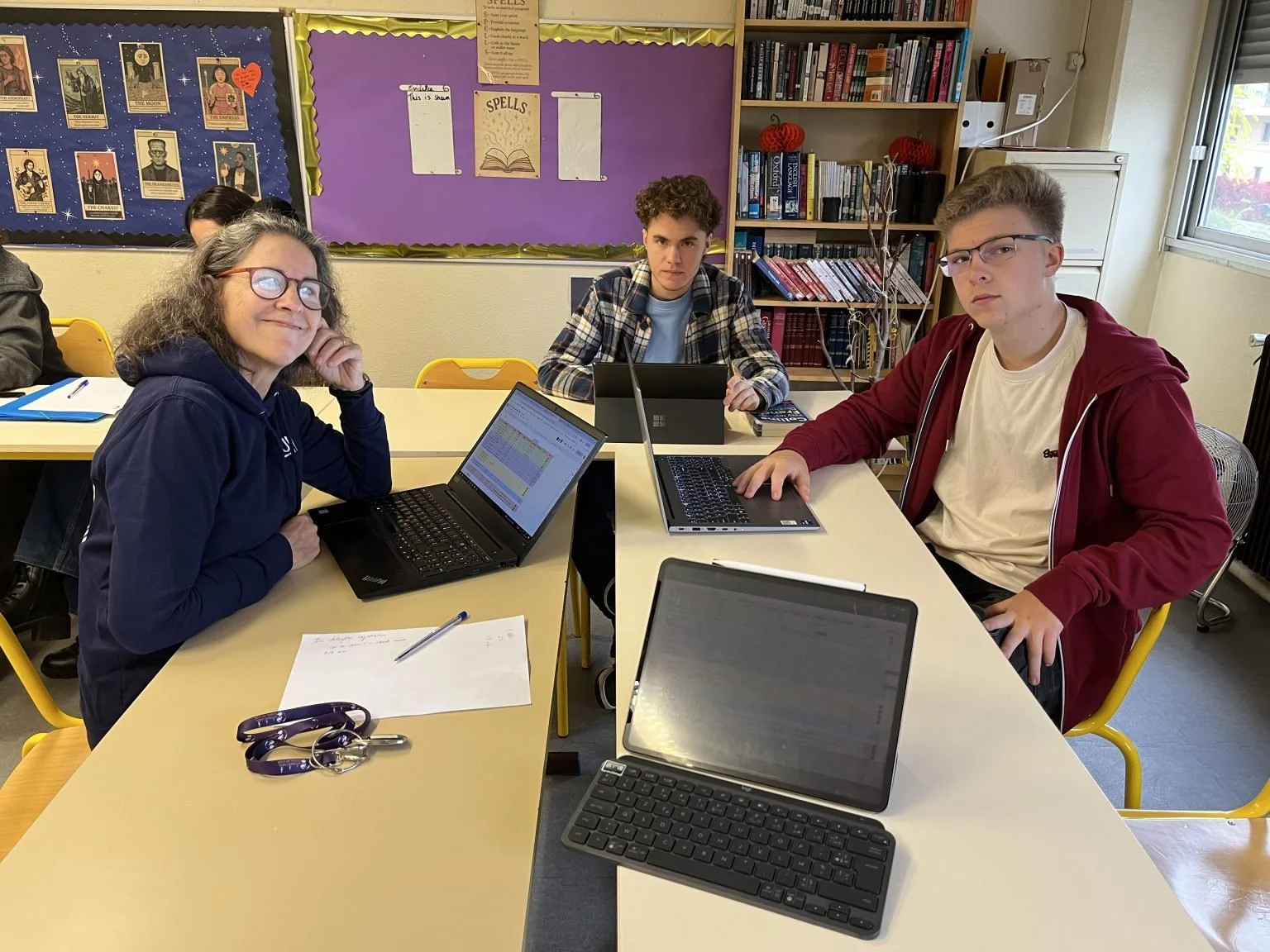
Ms. Trout in a meeting with the Heads of Logistics at ILYMUN 2026
So, first of all, I wanted to know how you and Tom Badou first met, and what inspired you to start working together in ILYMUN?
So Tom Badou is the office manager of the anglophone section of CSI (Cité Scolaire Internationale), and my own three sons actually went to CSI, so I knew him from that. I want to explain a little bit about the very first ILYMUN. The first ILYMUN was in April of 2013, and the way it happened was that two students at CSI, who had attended some MUN conferences earlier that year in 2012, decided they wanted to run their own conference. They went to the region, they made a proposal to the region, it was accepted, and then they went back to the director of the anglophone section, whose name was Rob Miller. The students then said, “We’re going to run a conference, and we’ve already got the region to support us.” So they did not go to their teachers first; they just went to the region. That was a real surprise to Mr. Miller, and he basically told them, “I’m not going to do this alone. What do you guys think about inviting ISL to join us in creating this conference?”
He knew me because my kids had gone to CSI, and he knew I was running the MUN club at ISL, so he basically called me and said, “Hey, do you want to organize an MUN conference with us?” So actually, Tom was not the main person that I was working with. I was working with Mr. Miller and Tom. Because he was the office assistant, he supported us with some administrative responsibilities, but that first conference was really run almost entirely by the students. Like I said, they had already arranged with the region when and how many rooms we would have and everything.
Each year, Tom became more involved, and when Mr. Miller retired, Tom became the adult supervisor at CSI. By then, even our titles had changed, so he and I are not called MUN directors; we’re called event managers because we run the event, or supervise the teams that are running the event. So that’s kind of how I know Tom and how he got involved and how I got involved.
That’s pretty cool. Has working together on ILYMUN changed your perspective on leadership or mentorship? If so, how?
So I’m really glad that you focused the first question about working together with CSI because I want people to understand that what makes ILYMUN unique is that it’s the only MUN conference that I know of that’s organized by two separate, distinct schools. Most MUN conferences are run by one school or maybe by a sister school with which they always collaborate with on other projects. But if you think about it, it would be a lot easier if it were just run by one school. It would be easier in terms of finding meeting times for the organizing team members, or in making decisions, or just in communication. It’s so much easier if it’s just one school.
But we decided from the very beginning not to do that. We decided to make it equally run by both schools and even the country delegations. In most MUN conferences, such as when we go to Berlin, our school, ISL, is given a country, so all ten students represent Germany, for instance, or all ten represent Colombia. They can work together to research about Colombia or about Germany. We’re all representing the same country. At ILYMUN, we don’t do that. We mix up countries so that one school is going to have a student representing China, a student representing Germany, a student representing Colombia, a student representing Japan, which means they actually have to work with students from other schools who are representing Japan or Germany. So when they come to ILYMUN and they get together in their countries, they’re not with their classmates. They’re with completely new people they’ve never met before. So the idea of working together with people we don’t know is really unique at ILYMUN.
So back to your question – how has that changed my perspective? Because we’ve set up the organization of ILYMUN so that there are two heads of logistics from CSI, two heads of logistics from ISL, ten press members from ISL, ten press members from CSI, and they’re working together, I think that offers you guys, the students, a more authentic leadership or mentorship opportunity. It would be one thing for Rohan, our head of written press, for example, to lead one group of press members that were only ISL. He could schedule meetings, and you’d all show up. He could hand out assignments. But because he has to work with another head who’s in charge of another team, and together those two heads have to plan who’s going to interview which guest, they have to work together. That’s what the real world is like. When you go to work, you’re not always just working with your team who has an office right next to you. You’re working with people from all over the world or from other sites.
Working together on ILYMUN and the way we’ve set it up has really reinforced for me what it means to be a leader and what it means to be a mentor, because you’re working with people that you don’t know, and that’s often what real leadership or mentorship is.
For me personally, that means I’m sometimes guiding students from CSI, even people that I don’t know. I edit the research reports, so I have to offer feedback to a student at CSI whom I’ve never met. I need to offer that feedback so that it’s helpful and encouraging. If I offer criticism and they don’t know me, it could sound harsh. So working together on ILYMUN has really changed my perspective on how I mentor people. I’m more aware of how I offer support or criticism, and it has taught me how important being really clear in communication is. You’ve got to share information with everybody involved, because there were years when maybe one of the SGs sent an email to only half of the SGs about something, thinking the others didn’t need to worry about it, but that makes people feel left out. Group dynamics are complicated. It just means you’ve got to include everybody in all the communication so it’s clear that we’re all sharing the same information.
Lastly, as a mentor, it’s really hard to sit back and refrain from steering people. Supportive feedback is important, but so is letting students make mistakes and try different strategies or propose new ideas. Tom and I could just say, “This is how we’re going to run the conference. Here are the committees. Here are the issues.” And there are a lot of schools that do that when they organize a conference. For example, “Here are the people who are going to be interviewing. We’ve chosen these journalists. Here’s the list of questions you need to ask.” And we could say it’s run by the students because you’re the ones doing it, but if we’ve set up everything for you, then we’re not letting you learn from it. We’re not being good mentors. So that’s how I’ve grown in my perspective on what it means to lead or to be a mentor.
And that helps the students learn to be leaders, too? Do you remember a particular conference or moment that stands out as unforgettable?
There are way too many unforgettable moments. Most of the moments that I think were amazing relate to when a student recognized how capable they were, or when a student realized how professional they’d been, or that they’d risen to the challenge.
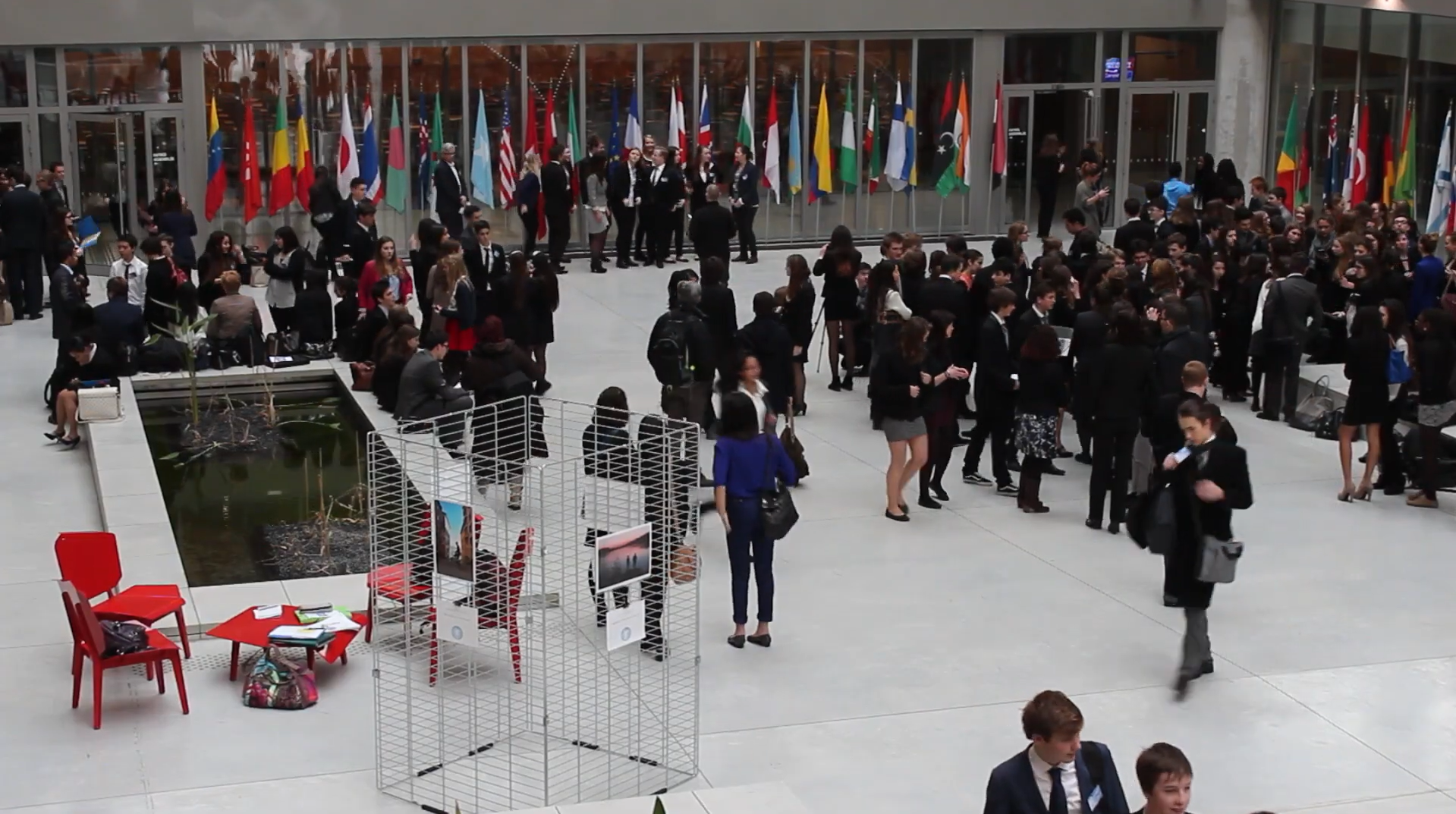
There was a time when we were setting up the salle d’assemblée, the big meeting room at the region, before the opening ceremony. We had about two hours before 500 people were arriving, and the head of logistics was there with a team of admins. Everyone was waiting to find out how to set up the room, and they all looked at me, including the head of logistics, even though she had already planned everything. They asked, “How do we start?” And I said, “This is your show. You know how to do it.” The look on her face when she realized she was in charge and she knew what to do was unforgettable.
Or when a host family emailed the day of the conference saying they had chicken pox in their house and couldn’t host. The school was arriving in a few hours and needed to know where their student would stay. The heads of housing figured it out in two hours, found a backup family, contacted them, and arranged everything. Seeing the realization on their faces that they had solved a real problem professionally is unforgettable.
Also, two conferences stand out. One was in 2021 because of COVID. It was a virtual conference, and I had doubts about how successful it would be. I couldn’t imagine debates and guest speakers over Zoom, but it really worked. The students created an atmosphere that was fun and brought people together, even though everyone was in their own homes.
The other was the second conference in 2014. The first one had worked, and we were building on it. There was real enthusiasm. We were trying new things and growing. My youngest son was involved in the press team that year, and I knew a lot of the students from CSI. It felt more like a family event because I was bringing together people I knew from ISL and CSI. That was really nice.
What was the most challenging moment you faced as MUN directors?
I’ll answer this in two ways: challenging moments as MUN director of the club, and for ILYMUN.
In 2015, we were planning to go to Berlin in mid-November, and a week before the conference, there were terrorist attacks in Paris and Saint-Denis on November 13. The government put a travel ban on all school trips. That meant we couldn’t go to Berlin. The students were devastated. But they turned it into something positive. They created a video that was shown at the opening ceremony in Berlin, expressing their frustration and resilience. They said terrorism wouldn’t stop them and that collaboration and sharing perspectives are ways to reduce extremism and fight racism. That was powerful.
For ILYMUN, COVID was the most challenging. We had to cancel the conference for 2020–2021. Students worked virtually and hoped it could happen, but it didn’t. That was really disappointing.
In 2024, the Hôtel de Région told us late that they couldn’t host us, and we didn’t know if we could have the conference. But the organizing team, Tom, and I didn’t give up. CSI hosted on Thursday afternoon, and ISL canceled lessons on Friday just so we could use the building. The support from administrations, families, and guest speakers was amazing. It showed creativity and problem-solving. I felt like the story How the Grinch Stole Christmas. You can’t stop Christmas from coming. I felt like you can’t stop ILYMUN from happening. Too many people believe in it. It’s going to happen somehow.
Looking back, would you have done anything differently?
I would have requested more time in my work schedule to devote to MUN and ILYMUN because I often feel torn between preparing ISL delegates and supervising ILYMUN organizing teams. I would also schedule more in-person meetings between the Secretaries-General and heads. It’s harder because we’re two schools with different timetables. We meet weekly separately, and near the conference almost every day, but rarely all together. In-person meetings make teams stronger.
What do you hope the future of MUN looks like at ISL?
I hope it continues to be a popular weekly club and remains student-run. Two students lead each year, choose topics and countries, and organize everything. I hope students continue attending international conferences and that ILYMUN continues, so students have leadership opportunities. Experienced members need to pass on their knowledge and enthusiasm so the club stays strong.
If you could give one final piece of advice to future delegates or MUN directors, what would it be?
To future delegates, I would say, “Challenge yourself.” Take on difficult countries, improve your public speaking, attend conferences, try different committees, join the organizing team, and take leadership roles.
To future MUN directors, I would say challenge yourself, attend conferences, and enjoy getting to know students outside the classroom. For me, MUN is about brainstorming and working with other people to solve problems. It’s about the power of discussion and dialogue. That power is what it takes to make change. You can’t make change unless you work with other people, and you can’t work with other people unless you have open dialogue and discussion.