
Intrusion vs. Protection: Evaluating the Ethics and Effectiveness of Digital Surveillance in Crime Prevention
Anaaya PATIL
Our modern world is evolving at a rapid pace. This transformation is significantly driven by growing interconnection through international networks. Criminal networks are now spreading faster than borders can contain them. This has led to increasingly intricate transnational crime. Over the years, transnational crime has expanded alongside global mobility, making its operations ever more elaborate. From digital money laundering to illicit trading and cyberharassment, these networks operate across many jurisdictions with a worrying ease. In response, law enforcement agencies have broadened their digital surveillance, marking a concrete evolution in modern crime prevention. However, these means raise numerous ethical and legal concerns, as they are often overlooked by large corporations or government organisations. This raises the question of whether protecting international security justifies intruding on personal privacy.

Credits: “the sociable” data surveillance blog
Digital Surveillance: Tools and Techniques in the Modern World
Digital surveillance can be loosely defined as the collection and analysis of electronic data. This includes the surveillance of communications, biometric indicators, financial records, online activity, etc… Unlike traditional policing, these tools allow authorities to track cross-border communications in real time, following the immense digital origins of organised crime. This surveillance strives to prevent global criminal activity.
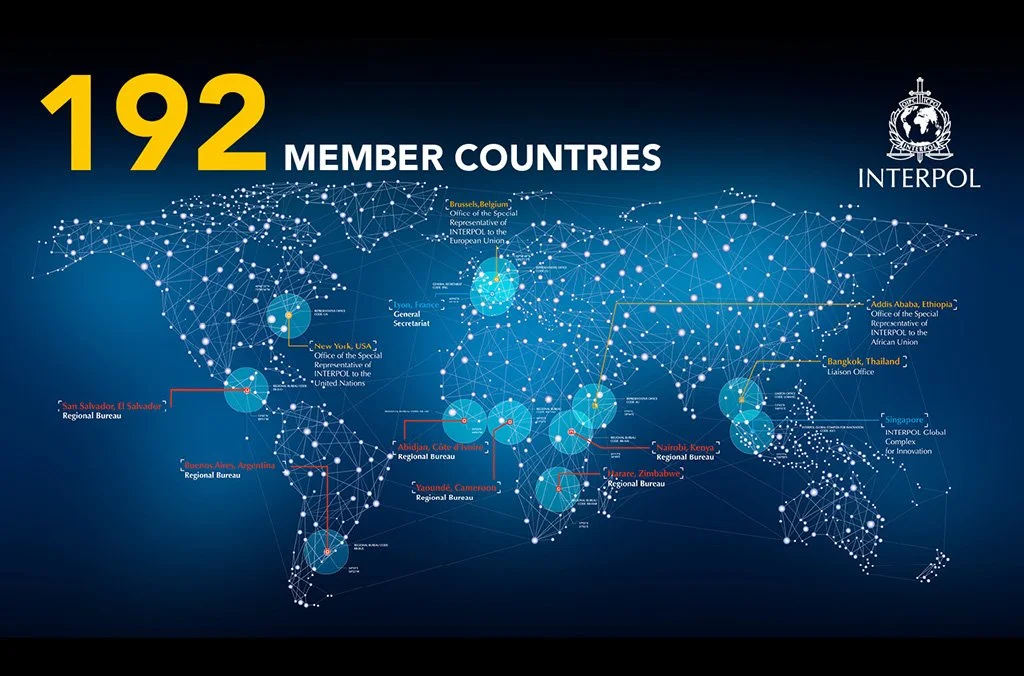

Map showing Interpol member states tied through digital-information sharing networks.
As a result, international law enforcement agencies have developed secure platforms to share data across countries. Biometric databases have now become essential by providing a reliable way to identify people using unique physical traits (such as fingerprints or facial features) and helping law enforcement officials track criminals and prevent identity fraud. Rapid alert systems also ensure real time information sharing and coordinate worldwide responses. This was most evident during the Operation Global Chain of June 2025. This was a coordinated international response to human trafficking, involving nearly 15,000 officers from 43 INTERPOL linked countries. The mission was led by law enforcement authorities in Austria and Romania. They were additionally provided with support from INTERPOL, Europol, and Frontex. The action focused on dismantling organised crime networks responsible for sexual exploitation and forced criminality, including begging. This operation successfully identified 1,194 potential victims, who often happened to be underage workers. To support cross‑border collaboration, a coordination centre was established at Frontex headquarters in Warsaw, Poland. Officers checked 924,392 individuals and issued raids that led to seizures of money, drugs, firearms, and fraudulent documents.
This comprehensive use of digital tools shows how international surveillance disrupts transnational trafficking and other crimes that traditional policing cannot effectively stop, such as drug smuggling and cybercrime.“A human being can only endure so much,” states Gary McDougall, former American politician. In contrast, modern day processors compute billions of instructions per second, making them much more efficient than any human being. Thanks to these technological advances, criminal activities taking place on encrypted messaging platforms are much easier to track through servers and computer databases. This is perfectly illustrated through the case of Pavel Durov, founder of the encrypted messaging app Telegram. In late August 2024, French authorities arrested him due to his app's potential association in criminal activities currently under investigation. The platform has facilitated drug and arms trafficking and has perpetuated child sexual abuse materials. Although Durov is not accused of committing these crimes, French prosecutors charged him with complicity due to Telegram’s refusal to cooperate with their demands, and their Russian counterparts’. His arrest highlights the challenge of regulating global social platforms that can be used to hide serious crime.
Ethical and Privacy Concerns
Despite its advantages, digital surveillance raises significant ethical questions. Mass data collection and facial recognition capture confidential and personal information. This information is collected from innocent individuals as well as criminal suspects in order to prevent crime, which sparks serious concerns about consent and the widespread circulation of personal data. Much of this information is hidden in the fine print of ‘terms and conditions’, which most users rarely read or fully understand. These agreements often outline how personal data, such as browsing habits, location, and metadata, can be collected or sold. Thus, users may unknowingly consent to extensive surveillance. Regulatory frameworks vary significantly between countries, making consistent verification of relayed information hard to maintain. While some states maintain strict data protection laws, others lack strong enough safeguards. This therefore complicates international data sharing.
Concerns have also emerged about “surveillance creep”. This means that tools designed to prevent serious crime gradually expand into population monitoring without sufficient legal barriers. In a means to control this misuse of data, the 27 countries of the EU are all legally obliged to allow free movement of personal data under GDPR rules. The General Data Protection Regulation (GDPR) is an EU law that governs how personal data can be collected, processed and stored. It aims to protect individuals’ privacy and give them control over their personal information. Under its rules, all processing of identifiable information must have a legal basis and respect individuals’ rights. For example, the Vienna based privacy advocacy group NOYB filed a criminal complaint in October 2025 against the American company Clearview AI. The company had been collecting facial-recognition data from publicly accessible images to build a facial‑recognition database, a practice that violated the GDPR. Similar violations by Clearview AI have occurred in France, Italy, Greece and the Netherlands, resulting in fines totaling up to nearly 100 million euros. As a consequence, the GDPR safeguards personal privacy in the context of surveillance technologies, requiring constant supervision given the sensitive information these channels relay. As seen in the map above, Interpol has a plethora of countries that share a vast amount of data everyday on a singular database, making it even more vulnerable to breaches.
Balancing Security and Rights
The primary challenge in digital surveillance is balancing collective security with individuals’ privacy, and recent international developments attempt to do just that. For example, the United Nations Convention against Cybercrime (Hanoi Convention) was signed in October 2025 by over 70 countries, providing the first universal legal framework for combating cyber crimes like ransomware, online fraud, and child exploitation. It facilitates cross-border sharing of electronic evidence while also aiming to respect human rights and data protection. Strategies include limiting data collection and retention, implementing stronger safeguards, and standardizing international guidelines for data sharing. These measures reduce the risk of misuse while maintaining effectiveness through privacy-preserving methods like data minimization and anonymization. In online investigations, commonplace tools like cookies—small files stored on users’ devices that track behaviour and interactions—play a secondary role in identifying suspicious patterns such as illicit transactions or access to illegal marketplaces. Regulations now require strict consent and purpose constraints on such tracking to protect privacy, except in cases where lawful suspicion of criminal activity and oversight justify limited access.
Conclusion
Digital surveillance is not to be considered strictly protective or intrusive. Its impact varies depending on how it is applied and regulated by different institutions. Maintaining a balance between security and privacy is essential to combatting transnational organised crime without undermining individuals’ privacy. Therefore, law enforcement agencies must uphold ethical standards and transparency, as protecting individual privacy requires international collaboration. As crime continues to cross borders, ensuring that surveillance tools are used responsibly is critical in preserving both international security and individual security as well.
Bibliography:
Interpol (n.d.) Global Policing and Information Sharing Systems. https://www.interpol.int/en/Who-we-are/Strategy2/Global-Policing-Goals?utm .
United Nations Office on Drugs and Crime (UNODC) (n.d.) Transnational Organized Crime and the Use of Technology. : https://www.unodc.org/unodc/en/cybercrime/convention/index.html.
European Union Agency for Fundamental Rights (n.d.) Surveillance, Privacy and Human Rights.https://www.jamesparker.dev/what-are-the-legal-frameworks-governing-government-surveillance/ .
Privacy International (n.d.) The Risks of Mass Surveillance.
Global Initiative (2025) Decoding the Message in the Telegram Case. https://globalinitiative.net/analysis/decoding-the-message-in-the-telegram-case/ .
noyb (2025) Criminal Complaint Against Facial Recognition Company Clearview AI. https://noyb.eu/en/criminal-complaint-against-facial-recognition-company-clearview-a .
Interpol (2025) Global Human Trafficking Operation Detects 1,194 Potential Victims, Arrests 158 Suspects. : https://www.interpol.int/en/News-and-Events/News/2025/Global-human-trafficking-operation-detects-1-194-potential-victims-arrests-158-suspects .
IBM (n.d.) General Data Protection Regulation (GDPR). : https://www.ibm.com/products/cloud/compliance/gdpr#:~:text=The%20General%20Data%20Protection%20Regulation%2C%20or%20GDPR%2C%20is%20a%20European,effect%20on%2025%20May%202018 .
Reuters (2025) EU Lays Out Guidelines on Misuse of AI by Employers, Websites, Police. : https://www.reuters.com/technology/artificial-intelligence/eu-lays-out-guidelines-misuse-ai-by-employers-websites-police-2025-02-04/ .
European Commission (2025) Commission Proposes UN Convention Against Cybercrime. : https://home-affairs.ec.europa.eu/news/commission-proposes-un-convention-against-cybercrime-2025-07-16_en .
Electronic Frontier Foundation (EFF) (2024) UN Cybercrime Draft Convention Dangerously Expands State Surveillance Powers. : https://www.eff.org/deeplinks/2024/07/un-cybercrime-draft-convention-dangerously-expands-state-surveillance-powers .
Campbell, D. (2006) ‘Surveillance Creep: New Manifestations of Data’, Radical History Review, 95, pp. 70–95. : https://read.dukeupress.edu/radical-history-review/article-abstract/2006/95/70/30069/Surveillance-Creep-New-Manifestations-of-Data? .
European Union (n.d.) Principles, Countries, History of the EU. : https://european-union.europa.eu/principles-countries-history/eu-countries_en .