
Is the United Nations’ impact significant enough to assure the protection of Women’s rights?
Sarah COLLIN
Gender-based violence against girls and women is a problematic violation of human rights. More than 1 out of 3 women (totalling about 840 million worldwide) have experienced sexual or other forms of violence due to their gender. This disproportion reveals the inequalities faced in our societies and highlights the urgent need for change. Women are also more likely to get hurt by the people they live with, like family members or even their husbands or partners. Today, crimes against women are some of the least reported due to stereotypes, gaps in criminal law and procedures, and victim blaming. Due to this discrimination, only 40% of women who experience violence seek help, according to a survey held by UN Women in November 2025. This leads to secondary victimisation and inadequate responses from criminal law institutions. The lack of formal reporting critically impacts legal institutions’ ability to respond accurately and effectively. This results in systemic failure as gender based violence remains invisible in official data, which makes the problem more difficult to target. Moreover, underreporting also engenders normalisation and can create skeptical responses from legal systems, as the crime will be treated like an incident or a rare occasion. The lack of consistency in reports results in inadequate protection for women and a failure to truly understand the psychological impacts of abuse, such as trauma. UN Women is a United Nations agency dedicated to tackling problems like early marriage, sexual assaults, domestic abuse, femicides, misogyny, inequalities in professional places, genital mutilation, human trafficking, and exploitation in order to fight for fundamental human rights.
The role of the United Nations
UN Women, created in 2010, is the main entity dedicated to gender equality, working to close the gender gap by managing the UN’s trust fund and leading the ‘UNITE to end violence against Women’ campaign to achieve equal opportunities for girls and women around the world.
This work builds on earlier global efforts to protect girls’ and women’s rights, such as the Beijing Platform for action. It was a visionary plan created in 1995, when more than 189 governments agreed to end gender based violence at ‘The Fourth World Conference on Women’. Its aim was to achieve a more peaceful world and a sustainable planet, but also ensure that girls’ and women’s rights were respected around the world. The United Nations aimed to guarantee that everyone could live free from discrimination and make their own decisions without being influenced by gender based violence. This project actually took action in each critical area of concern instead of just raising awareness by protesting or talking about the issues. The Beijing Platform Action Plan gave a clear map that each country needed to follow . Each government made commitments to improve and invest in laws, policies, or programs to keep the urgency of gender equality alive and visible. Ever since this project began, there have been improvements in legal protection against domestic and sexual violence, with 1 583 new laws passed across 193 countries. Additionally, governments have established support for survivors by providing legal aid, shelters, and healthcare access. There are more than 100 countries who have trained police to be able to help these survivors, marking a real step toward gender equality in the justice department. There have also been improvements in women’s economic rights like bans on employment discrimination. New services have been put in place to reduce unpaid care work, like looking after children, helping gender gaps close progressively.
Another primary legal tool used to challenge domestic laws and ensure protection for women is the Convention on the Elimination of All Forms of Discrimination against Women, also referred to as CEDAW. The convention was adopted by the United Nations in 1979, and it requires countries to eliminate any form of discrimination and promote equality for all women and girls. Governments that signed the convention have to regularly report on how they are actively making improvements in gender equality in laws or policies.
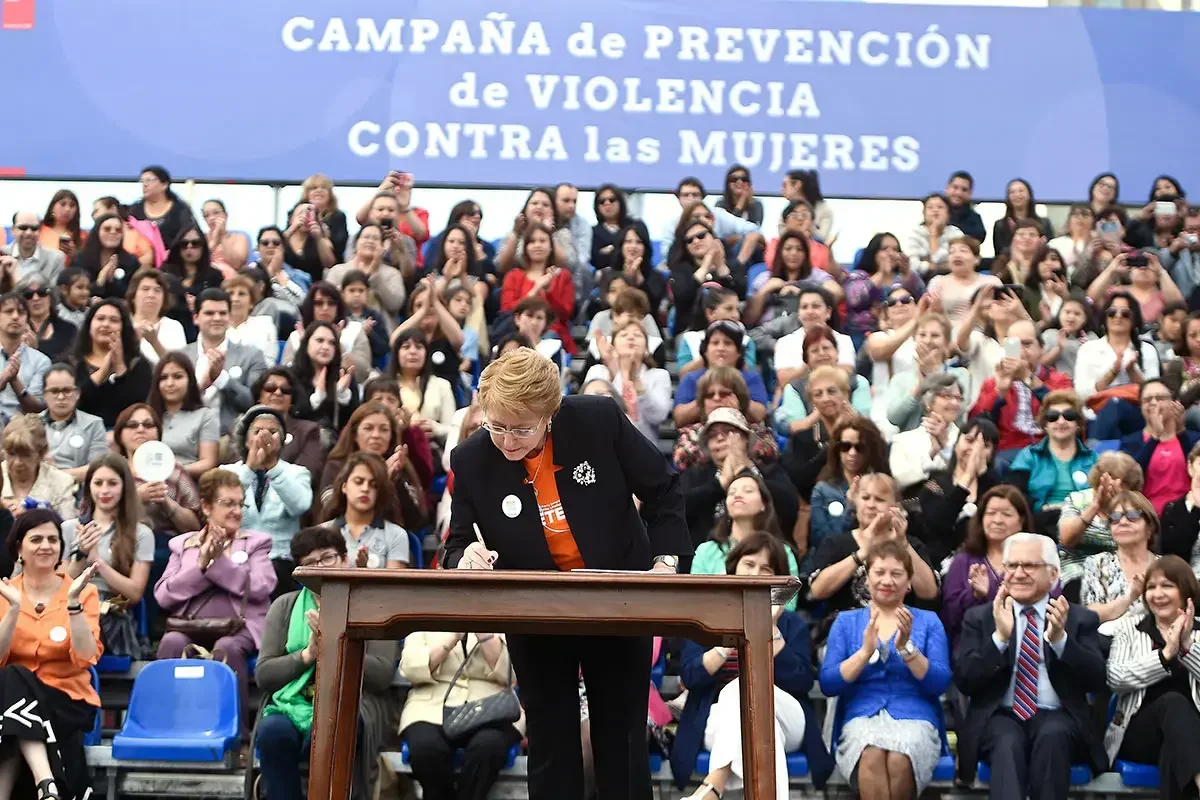
En 2016, la présidente du Chili, Michelle Bachelet, signe un projet de politique pour le droit des femmes à vivre sans violence. Photo : Présidence du Chili
However, the number of violences committed against women today is still very important as the world is failing to protect these basic human rights. Global emergencies like the Covid-19 crisis, conflicts, and digitalisation emphasised the factors that drive gender based violence. As the world creates new technologies and becomes more connected, it can exaggerate existing violences or even create new forms.
Although there has been significant progress, the UN still has a lot of work to do in order to eradicate gender based violence. It has created the necessary laws to prevent governments from justifying such violence and to ensure protection for women. However, the UN does not have the power to arrest individuals who violate these rights, meaning that legal protection exists, but it is not always practiced. The effectiveness of the law depends on how people follow it, the resources available, and the will to implement it of those in power. To assure legal protection against gender based violence does not just mean passing a bill or a treaty, but also making sure every woman can safely go to a courtroom and be heard, respected, and defended.
Bibliography
The general secretariat of the Council, ‘EU measure to end violence against Women’, in European council council of the European Union. 26 novembre 2024 last viewed on february 12 2026.
https://www.consilium.europa.eu/en/policies/eu-measures-end-violence-against-women/
UNODC, ‘Gender based violence against women’, in United Nations. Last viewed on february 12 2026.
new-gender-in-the-justice-system-vaw.html
Franklin de Vrieze, ‘How to ensure that legislation against gender based violence makes an impact’, in WFD. 29 november 2022, last viewed on february 12 2026.
https://www.wfd.org/commentary/how-ensure-legislation-against-gender-based-violence-makes-impact
UN Women, ‘Facts and figures: ending violence against women’, in UN Women. 19 november 2025, last viewed on february 12 2026.
UN Women, ‘Act to end violence against women’ in UN Women. July 2025, last viewed on february 12 2026.
https://www.unwomen.org/en/what-we-do/ending-violence-against-women/act
UN Women, ‘The Beijing declaration and platform for action at 30, and why that matters for gender equality’, in UN Women. 24 january 2025, last viewed on february 12 2026.
United Nations General Assembly resolution, ‘Convention on the elimination of all forms of discrimination against Women.’, in United Nations Human rights office of the high commissioner. 18 december 1979 last viewed on february 12 2026.